
Which set of textbooks should overseas Chinese choose to learn Chinese?
In recent years, overseas Chinese schools and learning resources have mushroomed, making it truly overwhelming for parents and students. As a teacher of Chinese as a foreign language with many years of experience (having taught multiple sets of textbooks), I know well that interest is crucial for children learning a language, and choosing the right textbook is the key to unlocking that interest.
As the saying goes, “it is hard to satisfy everyone.” Which textbook should overseas Chinese teaching adopt? The answer depends on specific learner circumstances: the child’s Chinese level, the amount of time they can devote to study, whether parents can participate and guide, and the parents’ expectations for their child’s proficiency.
Currently, the three main textbook choices for overseas Chinese families are:
- Ma Liping Chinese Textbook: https://www.heritagechinese.com/website/page/browse/
- New Shuangshuang Chinese Textbook (2nd Edition): https://www.shuangbookstore.com/
- Tongle Chinese Textbook: https://www.tonglec.org/zh-hans/tongle-originals
Let’s compare these three textbooks from three aspects: Chinese characters, reading, and culture.
I. Chinese Characters
Ma Liping Chinese Textbook integrates lessons, new characters, and writing practice into one book. This makes it convenient for students to organize their learning materials and quickly review by referring back to the texts. The detailed bilingual explanations are particularly helpful for children with weaker foundations. However, the large number of new characters—such as nearly all characters from the first lesson being listed—may create feelings of intimidation.
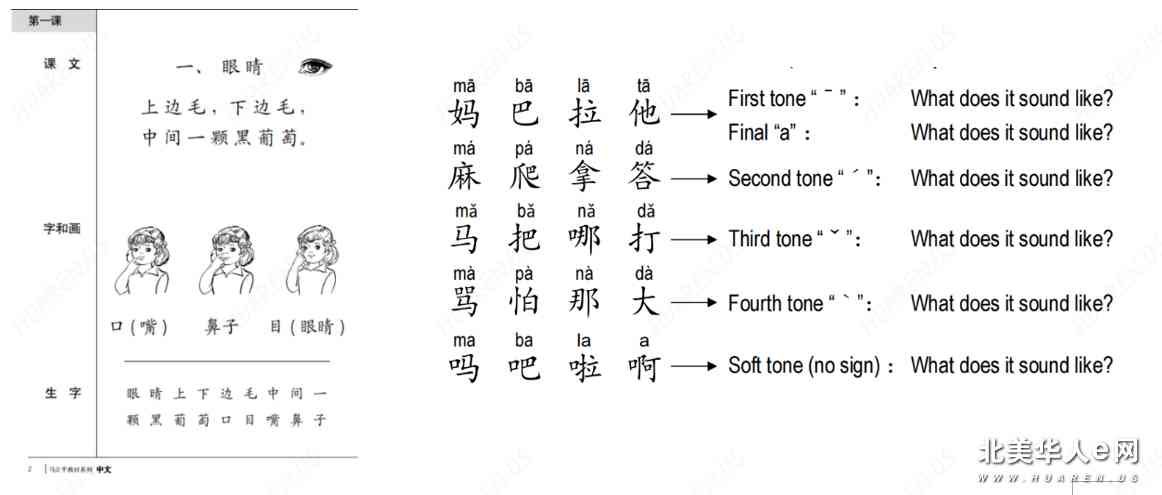
New Shuangshuang Chinese Textbook shares similarities with Ma Liping, reflecting the style of domestic Chinese textbooks. From Grade 3, it systematically introduces Pinyin, radicals, and basic grammar, combining texts, new characters, writing, and exercises in an integrated way. While this clarity is useful, an entire year at Grade 3 is devoted to grammar foundations. This may be necessary in an environment where Chinese is widely used, but overseas families should carefully consider whether it meets their needs.
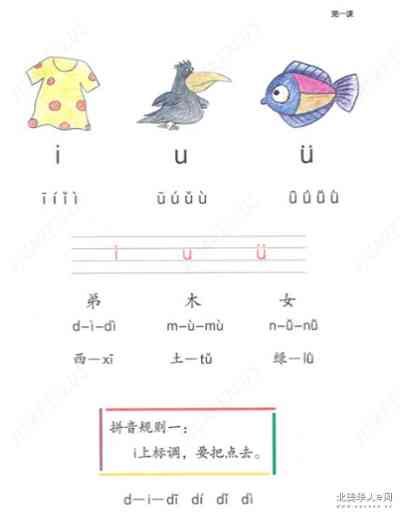
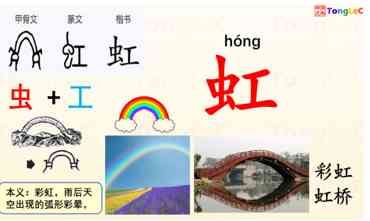
Tongle’s character series “The Hidden Meaning of Characters” (字裡藏意) takes a different approach. By presenting ancient scripts such as oracle bone inscriptions, bronze script, and seal script, it explains the evolution and original meanings of characters. This not only helps children remember characters but also exposes them to the cultural significance of Chinese writing. At the same time, knowledge is extended into fields like history, geography, and science. For example, when learning the character “虹” (rainbow), students also learn how rainbows form and the difference between 虹 and 霓; when learning “漢,” they explore its origin in the Han River and its metaphorical extension to the Milky Way, linking it to Cao Cao’s poem “The stars shine brilliantly across the Milky Way.”
Unlike the heavy after-class review exercises in the other two series, Tongle streamlines them into weekly assignments. This reduces workload but requires students to stay attentive in class to fully absorb knowledge.
II. Reading
Grades 4 and 5 are often seen as the critical turning point in Chinese learning.
In Ma Liping, by the end of Grade 4, the “character recognition and reading” stage is declared complete. Lessons continue to focus on “texts + characters.” The first month of Grade 5 is dedicated to Pinyin, input methods, and dictionary use—showing its commitment to the traditional foundation of character-centered learning.
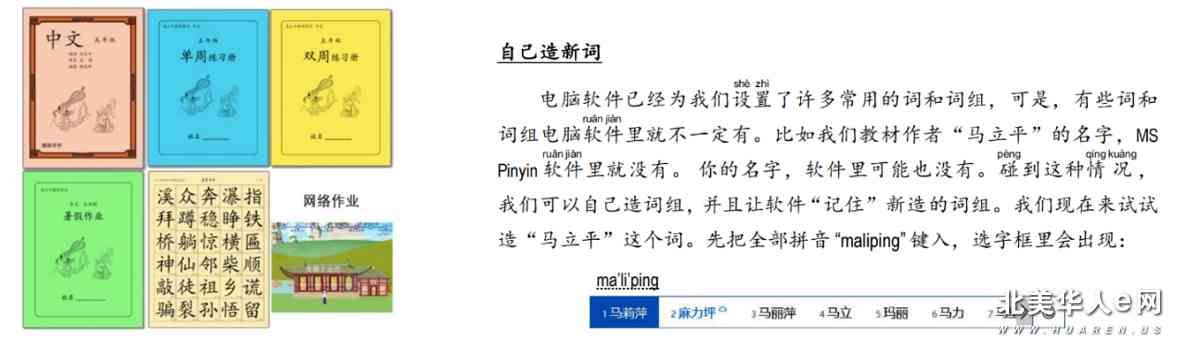
New Shuangshuang formally concludes by Grade 5, with Grade 6 shifting to thematic readings such as idioms, history, and philosophy. However, most texts are short to medium length, offering limited reading volume. More importantly, children only begin exposure to these genres at Grade 6, missing out on the golden memory years of younger grades.
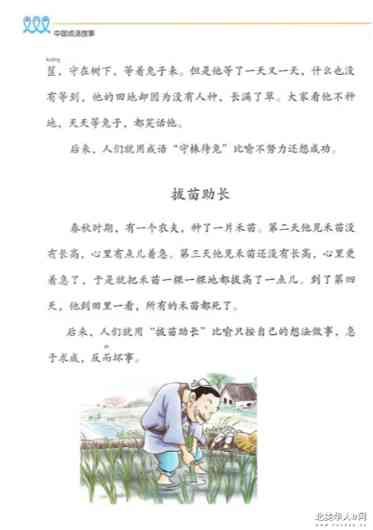
Tongle Chinese Textbooks stand out by following children’s natural growth patterns. Each grade provides multiple types of books—characters, reading, classical poetry, idioms, cultural knowledge—woven into an integrated curriculum. With constant exposure to rich, high-quality texts, students naturally gain the ability to read longer passages without heavy after-class assignments. This explains why parents often find their child’s Chinese suddenly improving dramatically in higher grades—it is the result of long-term accumulation.
III. Culture
Most overseas Chinese schools incorporate Chinese culture into teaching. However, the depth of cultural integration differs among the three textbook series.
From its founding, Tongle Chinese has promoted the idea of “culture first, characters second.” Classical Chinese content—storytelling, pre-Qin classics, poetry—is included across all grades. Recently, new beginner courses allow families to choose between focusing on pre-Qin classics or poetry. Each grade also has themed cultural modules, from idioms and cultural phrases in the lower levels to history, geography, the Three Kingdoms, festivals, and seasonal traditions in higher levels. Embedding profound cultural wisdom in lessons ensures that children internalize values naturally—for example, sayings like “When three walk together, there must be one I can learn from” endure because of such early exposure.
New Shuangshuang also emphasizes cultural integration, having developed nine volumes of cultural readers. These can be studied independently by students with little Chinese foundation but an interest in culture, adding flexibility. Within the classroom, the focus is on maintaining consistency across grade levels. In contrast, Tongle emphasizes the child’s long-term growth (5–10 years), providing wide-ranging content across literature, history, philosophy, and science to foster not just language ability but also worldview and cultural literacy.
Ma Liping, however, prioritizes characters as the main hurdle to overcome. This approach aligns with many overseas programs that emphasize recognition first, meeting urgent parent demands. Even in higher grades, it continues reinforcing basics like Pinyin and typing, highlighting its focus on foundational grammar.
IV. Which Textbook Should Overseas Families Choose?
In my personal opinion, I prefer Tongle Chinese Textbooks. Unlike traditional materials filled with annotations, after-class exercises, and drills, Tongle emphasizes two points:
- Integration with classroom teaching – knowledge is reinforced and expanded, helping children connect and recall points naturally.
- Fostering initiative – children learn to seize every classroom moment, making the textbook a true review aid rather than just extra homework.
For children, this presents both opportunities and challenges. In the early stages, parents may need to help establish good study habits. But in the long run, language learning and cultural development can advance together.
Of course, every family has different goals. For those who simply want their child to learn a few characters and basic spoken Chinese, Tongle’s comprehensive cultural approach may not be the best fit. But for families who value long-term growth and character development, Tongle offers a unique and powerful path.